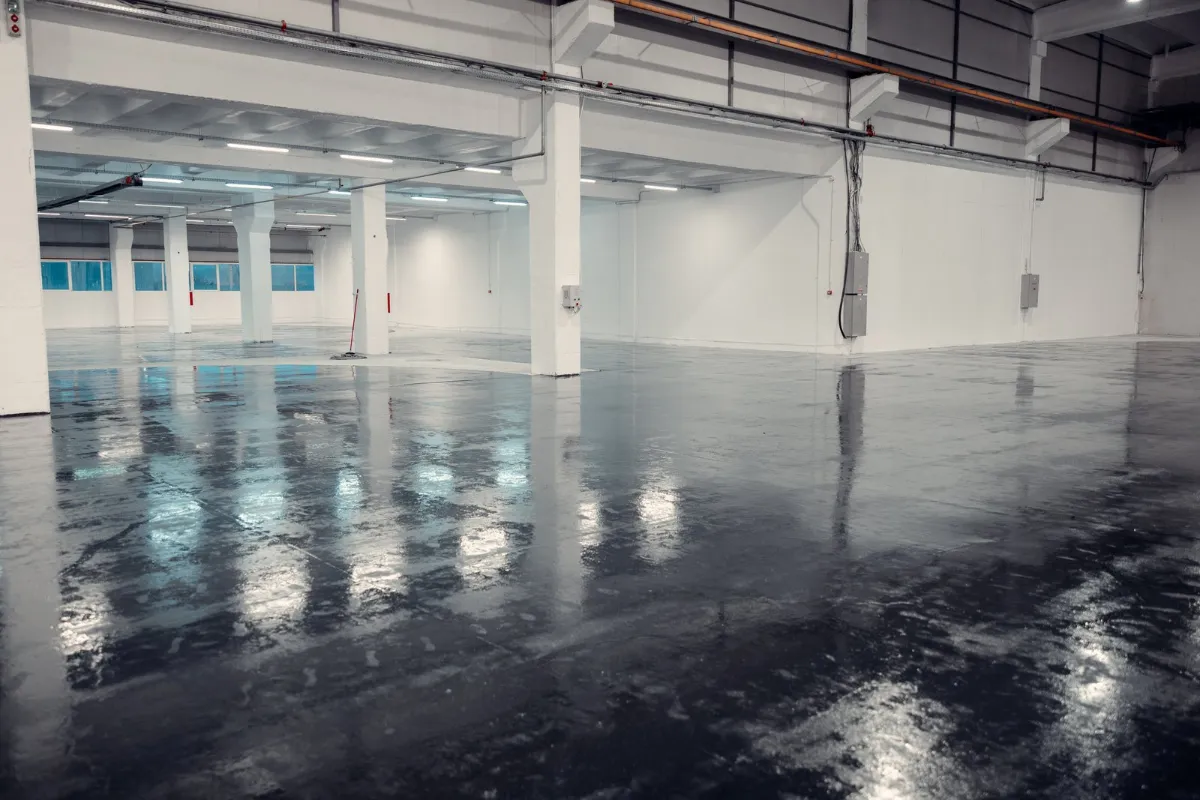
What industrial traffic does to concrete
Industrial floors absorb a kind of punishment homes never see. Forklifts with hard polyurethane wheels pivot, accelerate and brake in the same lanes for hours. Pallets are dragged. Hand trucks and carts roll across every joint. Over months and years, that abrasion grinds away the surface, creating dust that settles on inventory, clogs filters and wears equipment.
Joints are hit hardest. Each time a wheel crosses an unsupported joint edge, it chips a little more away. Eventually those edges spall into rough channels that jolt equipment and loads. The repairs get more expensive the longer they wait.
A well-specified industrial coating addresses all of it — sealing the surface, protecting joints, resisting abrasion and making the floor far easier to clean.
Benefits for facilities
Dust-proofing
Sealed or densified concrete stops the constant dusting that settles on stock and equipment.
Wear resistance
High-build coatings protect travel lanes, turns and dock areas from forklift abrasion.
Organized, safer traffic
Striping separates pedestrians from equipment and marks storage and hazard zones.
Brighter work areas
Pale, bright surfaces help drivers and pickers see what’s around them.
Protected joints
Rebuilt edges and proper fillers give wheels a smooth ride.
Easier maintenance
Sealed surfaces sweep and scrub faster.
Choosing protection zone by zone
Densifier and sealer
A budget-friendly way to toughen and de-dust low-traffic storage. No color, limited chemical resistance.
High-build epoxy
Thick, durable coatings for aisles and workspaces with constant forklift and foot traffic.
Epoxy with urethane top
Adds chemical and scratch resistance for maintenance bays and areas with frequent spills.
Slip-resistant aggregate
Textured finishes for ramps, docks and washdown zones.
Line striping
Durable markings for lanes, walkways, staging squares and hazard areas.
Our industrial process
- 01
Facility walk
We study traffic flow, loads, chemicals, joint condition and moisture with your operations team.
- 02
Phasing plan
The floor is divided into sections so inventory moves and work continues.
- 03
Surface prep
Contamination comes off by grinder or shot blaster, and broken areas are rebuilt.
- 04
Joint rebuild
Spalled edges are rebuilt and joints filled with semi-rigid material.
- 05
Coating
Each zone receives its specified system with proper cure time before traffic.
- 06
Striping and handover
Lines and markings go down, and your team receives care guidance.
Designing a striping layout people follow
Striping only improves safety if it reflects how a building actually works. We shadow your shift lead first, noting the turns forklifts take, the shortcuts people use and the spots that bottleneck. The layout is then drawn to match real movement rather than an idealized plan.
- Forklift lanes with marked turning areas at intersections
- Pedestrian walkways in a contrasting color
- Stop bars and crosswalks at doorways and blind corners
- Keep-clear hatching around panels, extinguishers and eyewash stations
- Staging squares near loading doors
- Bay and rack numbering for picking and inventory
Why large floors expose shortcuts
On a big slab, every compromise becomes visible. Thin coatings wear through in turning zones. Poor prep shows up as peeling in forklift lanes. Soft joint fillers get chewed out within months. Each failure means another shutdown and another bill. We plan carefully, prepare thoroughly and build appropriate thickness in each zone so your facility only goes through this once.
A warehouse floor should disrupt your operation once — not every year.
Industrial floors along the I-17 corridor
North of Phoenix, the I-17 corridor includes storage facilities, contractor yards and shops, and light-industrial buildings serving the growing north Valley. Large doors open to the desert let dust blow in constantly. Ground into the floor by wheels, that dust behaves like an abrasive. Sealed, wear-resistant coatings stand up to it much better than bare concrete.
Many of these buildings are metal structures without air conditioning, where slabs see broad temperature swings. We select coatings and joint fillers that tolerate that movement.
Moisture and contamination in older slabs
Concrete poured without a moisture barrier may breathe water vapor that bubbles up beneath a sealed finish. Years of absorbed oil or chemicals can prevent adhesion. Moisture meters and a hunt for oil-soaked zones are part of the walkthrough; vapor-blocking primers or extra degreasing go in the plan if needed.
Keeping it performing
Regular sweeping or ride-on scrubbing with the softest effective pads removes the grit that wears coatings fastest. Watch joints and door thresholds, which wear first, and repair small chips early. Striping in the busiest turns can be refreshed without recoating the floor.
Densifier or full coating?
This is the most common question facility managers ask. Densifiers soak into concrete and chemically toughen the top, cutting dust sharply without a big outlay. It leaves the floor’s color unchanged and adds limited protection against spills and chemicals. Striping on densified concrete also tends to wear faster than on a coating.
Go with a full coating when spills, brightness, defined zones or fast cleanup are priorities. Many facilities split the difference: coatings in aisles, shops and work areas, densified concrete beneath long-term racking. We’ll price both approaches so you can compare.
Contractor shops and fleet bays
Contractors and service companies along the I-17 corridor often run mixed-use buildings: an office up front, material storage in the middle and vehicle or equipment bays at the back. The bays see oil, hydraulic fluid, coolant, mud and heavy loads from trucks and trailers.
For these spaces we specify a heavier build with a chemical-resistant topcoat and added aggregate near wash areas and doors. Light colors make dropped parts easier to find and brighten bays that may only have a few fixtures. Storage areas can often use a densifier to keep costs reasonable.
Safety color conventions
Sticking to one scheme matters most. Common practice: yellow for travel paths and caution, white for racks and machines, red around fire gear, green near first-aid points, and striped hatching wherever the floor must stay clear. We’ll help you settle on a scheme and apply it consistently across the building.
Minimizing downtime
Every hour a facility is down costs money. Working in sections keeps most of the building productive. Quick-setting products shorten each closure, and off-hours shifts keep the noise away from your busiest times. We build the schedule with your team before work begins, so there are no surprises.
What drives the cost of an industrial floor
Square footage matters, but the bigger variables are slab condition and system choice. Contaminated or damaged concrete takes more preparation. Joint rebuilding is priced by length and condition. High-build coatings and urethane topcoats cost more than densifiers, and striping complexity varies widely. Scheduling — nights, weekends and phasing — also affects price. Our proposals break out each factor so you can make informed trade-offs.
Storage units and small industrial suites
Not every industrial project is a large warehouse. Small flex suites, contractor storage units and maintenance rooms benefit from the same treatment on a smaller scale: dust-proofing, a durable coating in work areas and a few clear safety lines. These projects can often be completed over a weekend.
Coordinating with your safety program
If your facility follows a written safety program or works with an insurer’s loss-control team, we’re glad to align the striping plan with their recommendations. Sharing a layout drawing before installation lets everyone review lane widths, crossings and keep-clear zones while changes are still easy to make.
Pre-project checklist for facility managers
A little preparation on your side makes the work go faster and keeps costs predictable.
- Share a floor plan or sketch showing racking, doors and equipment
- Note any chemicals stored or used on the floor
- Flag areas that must stay open during each phase
- Confirm power and water access for our equipment
- Identify the contact who can approve layout changes on site
Common questions
Can you work while we operate?
Yes. We phase the work and schedule nights and weekends to keep you running.
When can forklifts return?
It depends on the system and temperature — from the next shift to several days.
Do we need to coat everything?
Not necessarily. Many facilities coat lanes and work areas and densify storage zones.
How are damaged joints fixed?
We rebuild spalled edges and fill joints with semi-rigid material that supports wheels.
Can you restripe an existing floor?
Yes, striping can be added or refreshed on coated or densified floors.
Is a coated floor slippery for forklifts?
Smooth gloss can be slick when wet or dusty. Ramps, dock plates and wash zones get grit mixed in for traction.
How long does an industrial coating last?
It depends on traffic, system and maintenance. Thicker builds outlast thin ones in busy aisles, and a periodic clear-coat refresh stretches them further.
Do you work on small industrial suites?
Yes. We coat spaces of all sizes, from a single storage unit to a full warehouse.